
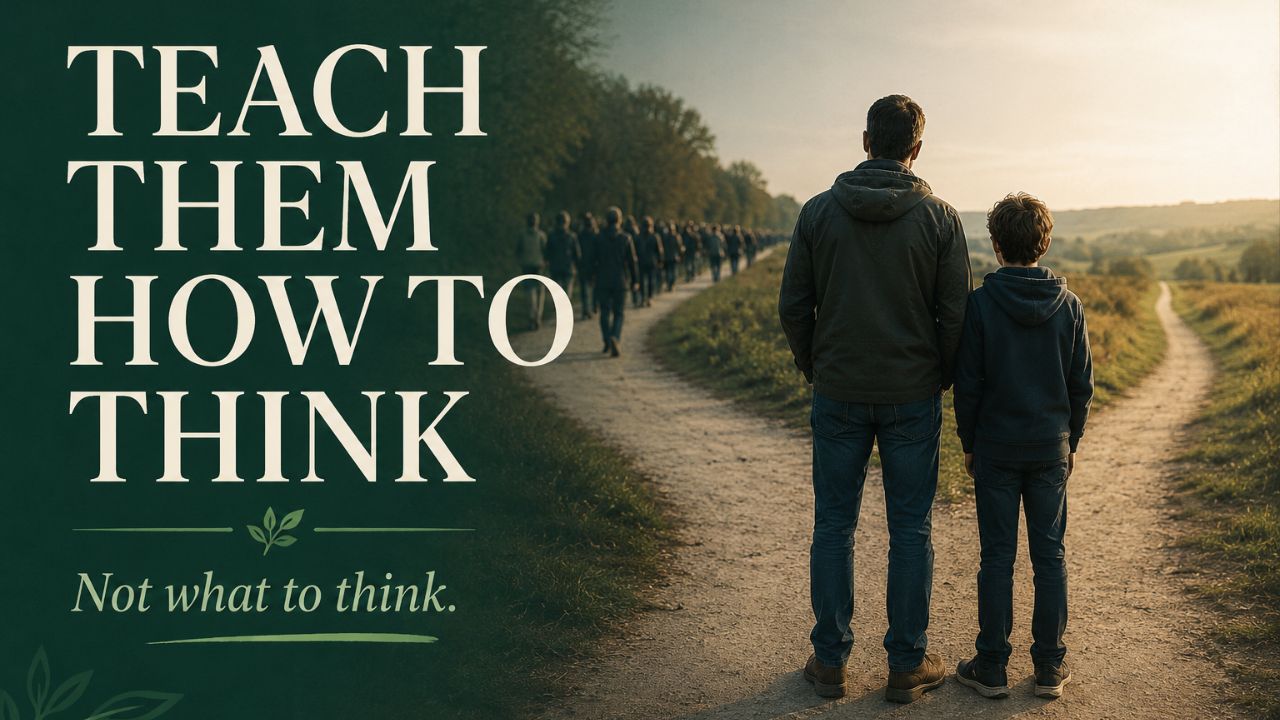
If We Want Our Children to Thrive, We Need to Teach Them How to Think
I've been thinking about this a lot recently.
As parents, grandparents, teachers... perhaps one of the greatest gifts we can give the next generation isn't having all the answers.
It's showing them that we're willing and able to change our minds.
To admit when we were wrong.
To keep learning.
To course-correct when new evidence appears.
Many of us were brought up believing things like:
"Trust the science."
"Follow the rules."
"Doctors know best."
"A university degree is essential if you want to succeed."
"You can't do that."
Some of those beliefs may have served us well. Some may still do.
The question isn't whether they're right or wrong.
The question is...
How many of the beliefs that shape your life today did you consciously choose, and how many did you simply inherit?
That isn't a criticism.
It's an invitation.
The world our children / young adults are growing up in is changing at a pace we've never experienced before.
Artificial intelligence is here.
Digital identity is becoming a reality.
Cashless societies are expanding.
Technology is reshaping almost every aspect of life.
Whether you see these changes as exciting, concerning, or somewhere in between isn't really my point.
The point is that the ability to think critically, stay adaptable and make conscious decisions has never been more important.
The past six years alone have taught us an enormous amount.
Whether you believe the pandemic was a public health emergency, a massive exercise in behavioural control, a political turning point, or a combination of all three, one thing is undeniable: it forced many of us to question assumptions we'd accepted for years without ever examining them.
Previous generations experienced world wars that reshaped society. Every generation faces defining moments that change the way we live, think and behave. History has always demanded adaptation... but adaptation to what? And perhaps the more uncomfortable question is... who gets to decide what becomes the "new normal"? Change itself isn't the danger, unquestioned change is. Are we consciously choosing the future we're creating, or are we being coerced into adapting to someone else's vision of it without ever stopping to ask who benefits?
One important question is...
Are we still holding onto the idea that changing our mind somehow makes us weak?
I believe the opposite.
Being willing to change your mind in the light of new evidence is one of the greatest strengths an adult can possess.
In some situations, it could even save your life.
Children don't become what we tell them to become.
They become what they see us being.
If they never see us say, "I got that wrong," they'll struggle to say it themselves.
If they never see us question our own thinking, they'll assume certainty is more important than curiosity.
For me, one of the greatest gifts I can give my children isn't a list of answers.
It's the courage and the confidence to think for themselves.
To question respectfully.
To step away from the crowd when something doesn't feel right.
To make their own decisions.
And to take responsibility for those decisions.
Changing your mind when the evidence changes is a strength.
Staying curious is a strength.
Questioning yourself is a strength.
After all...
A mind is a bit like a parachute.
It only really works when it's open.
The older I get, the more I realise that one of life's greatest skills isn't collecting more information.
It's becoming aware of what's been shaping your decisions in the first place.
Our beliefs.
Our habits.
Our fears.
Our culture.
The people we've listened to.
The stories we've repeated without ever stopping to ask...
"Is this actually true?"
That kind of awareness changes everything.
Of course, the moment you begin questioning accepted ideas, don't be surprised if you're mocked.
People like certainty.
Crowds feel safe.
Standing apart rarely does.
History is full of people who were laughed at before they were listened to.
And here's where I was going to make a joke about not following the crowd "like lemmings."
Apparently, lemmings don't actually throw themselves off cliffs at all. That was a myth helped along by an old Disney documentary.
Which rather proves the point.
How many things do we know that we've never actually questioned?
Perhaps the greatest lesson we can teach our children isn't what to think.
It's how to think.
To be able to say,
"I used to believe that... but now I see it differently."
That isn't weakness.
That's growth.
So let me leave you with a question...
What belief have you changed your mind about in the last five years, and what gave you the courage to question it in the first place?
If that question makes you pause, you're not alone.
Much of my one-to-one coaching isn't about giving people more information. It's about helping them recognise the unconscious beliefs, patterns and programmes that have been shaping their decisions for years, often without them even realising it.
Once you can see the pattern, you have a choice.
And choice is where freedom begins.
If that's something you'd like support with, I'd love to help.